
Fire door inspections, remedial works and clear records for commercial and residential buildings across Wirral, Liverpool, Chester and the North West.
Accredited and certified
Overview
Fire doors are moving parts. They are opened, closed, kicked, wedged and drilled through every working day, and each of those actions wears away the performance they were tested to deliver. We inspect fire doors, repair the defects we find and keep the records that show your building is compliant: one directly employed team, one report and one point of contact.
92%
of fire doors over five years old that David Egan has inspected had at least one non-compliant aspect

David is an electrician by trade and leads facilities operations at Oculus. He is also our fire door specialist, with BM TRADA and RoSPA fire door training.
Maintenance
Component-by-component checks of every fire door, recorded with photographs and graded by priority.
Replacement seals, adjusted gaps, corrected closers and suitable hardware, carried out by the team that found the defect.
An auditable history of every inspection and repair, ready for your fire risk assessor, insurer or enforcing authority.
Quarterly, six-monthly or annual cycles built around your building, your legal duties and how each door is used.
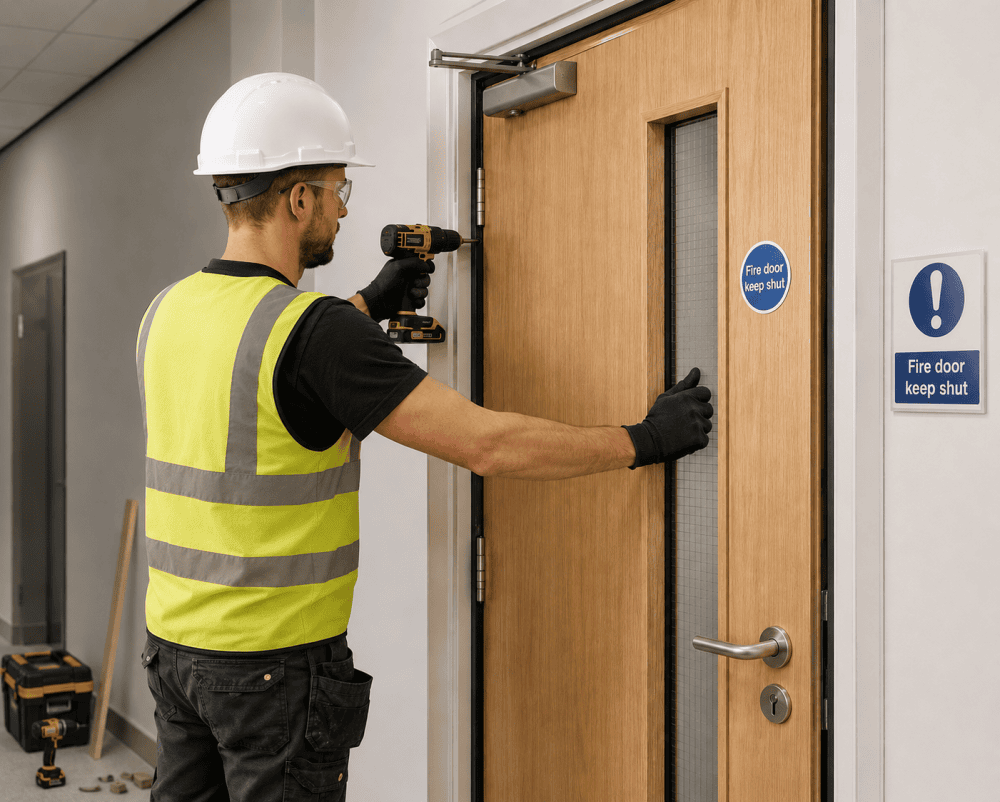
A fire door holds back fire and smoke long enough to protect the escape route. It can only do that if every part of the assembly works together: leaf, frame, intumescent and smoke seals, hinges, closer, glazing and signage.
We check each component on every door, confirm the door closes fully onto its latch from any opening angle, measure the gaps around the leaf and look for alterations such as holes drilled for cables or unapproved hardware. Every door is recorded with photographs, a list of defects and a priority grade.
The faults we find most often are excessive gaps, worn hinges and damaged leading edges, followed by doors wedged open, missing or painted-over seals and unauthorised alterations. For a quick check of your own, try the pound coin test in our fire door safety guide.
Fire door compliance
There is no single statutory fire door compliance certificate, and a contractor offering a one-off certificate that “proves” compliance is overselling it. Compliance is evidenced by the door’s own certification label or plug, and by a record of what has happened to it since: when it was inspected, by whom, what was found and what was done.
That record is where most buildings fall short, and it is what fire risk assessors, insurers and enforcing authorities ask to see. After every inspection you receive:


Fire door compliance
For multi-occupied residential buildings in England above 11 metres, communal fire doors must be checked at least every three months, and flat entrance doors at least every 12 months on a best endeavours basis, with a record kept where access is refused. Both checks must confirm that self-closing devices work.
In any building with two or more sets of domestic premises and common parts, residents must be told at least once a year to keep fire doors shut, not to tamper with self-closers and to report faults. Under the Building Safety Act 2022, duty holders are increasingly asked to evidence who carried out checks and what happened next, which makes the record as important as the inspection.
Why Oculus
Our fire door work is led by David Egan, Facilities Operations Director, an electrician by trade with fire door safety training from BM TRADA and RoSPA.
Our directly employed, multi-skilled engineers fix the defects our inspections find, so you are not chasing a second contractor.
From our base in Bromborough we cover Wirral, Liverpool, Chester and the wider North West.
ISO 9001 certified, SafeContractor approved and CHAS accredited.
Case studies

Facilities management
Open conversations led to recommendations that made efficiencies and relieved pressure on the client’s facilities resources.
Cleaning, grounds and repairs
A service plan built around the client: daily cleaning, grounds maintenance and reactive repairs.
More maintenance services
Scheduled inspections and servicing that find and fix problems early.
Repairs when something goes wrong, booked through our 24/7 phone line.
Vinyl, resin, carpet, timber and safety flooring, from repairs to multi-site programmes.
It means a fire door still performs to the standard it was tested and certified to, is maintained in that condition and has records to prove it. That covers the leaf, frame, gaps, seals, hinges, closer, glazing and signage working together, plus a documented history of inspections and repairs.
There is no single statutory certificate. Compliance is evidenced by the door’s certification label or plug and by a documented record of inspections, defects and remedial work. After every inspection we provide a door-by-door report that forms that record.
In multi-occupied residential buildings in England above 11 metres, communal fire doors must be checked at least every three months and flat entrance doors at least every 12 months on a best endeavours basis. In other buildings, your fire risk assessment sets the frequency. We recommend quarterly professional checks for high-traffic doors and a monthly visual check of every door.
We check the leaf, frame, gaps, intumescent and smoke seals, hinges, closer, latch, glazing, signage and any alterations, and confirm the door closes fully onto its latch from any angle. Every door is recorded with photographs, defects and a priority grade.
The Responsible Person under the Regulatory Reform (Fire Safety) Order 2005: usually the employer, building owner, landlord or managing agent. The legal duty cannot be delegated, but inspection, maintenance and record-keeping can be contracted to a competent specialist.
Yes. The same team recommends the fix and carries out the remedial work, from seals and gaps to closers and hardware, and records exactly what was done to which door.
Occupants are put at risk and the Responsible Person is exposed. Enforcing authorities, usually the local fire and rescue service, can issue enforcement or prohibition notices and prosecute under the Fire Safety Order. Insurers may also question cover.
Offices, schools, warehouses, healthcare premises, retail units and residential blocks across Wirral, Liverpool, Chester and the wider North West.
Free site audit
Tell us about your site. A manager will arrange a visit, assess what you need and send clear recommendations with costs. No obligation.